

African Magic


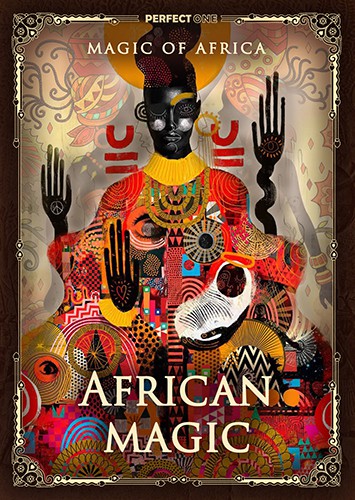
Author: Ben Chelero
When we talk about magic, we often attach our own opinion of the word to the concept, essentially turning it into our own magic based on its definition. In fact, it is a crucial existential object that is beyond comprehension unless the brain has specific frequency characteristics.
African magic has its own language and philosophy that we want to understand in our language. And that is impossible because one needs to learn the language of rhythm first. African magic is a system of communicating with the space and a special perception of it. While you want to go and talk to your girlfriend, an African wants to talk to celestial vibrations. It may seem crazy to us, but for them it’s natural brain activity.
African magic is a product of the development of African culture, which should be divided not into tribes and nationalities but based on the type of activity and—above all—brain operations. Therefore, it is not only difficult for us to perceive this sound, but we also need to be able to interpret this knowledge from a corresponding brain, or at least know how to perceive it. Another interesting matter is the applied aspect of African magic—that is, communication with space, to which certain corrections were made at a certain point.
African magic should also be considered in relation to the events of the colonial period when Africa was bled dry during the European colonization (around 100 million people were taken away or died). These events did, of course, affect the development of the whole of African culture. And this aspect is actually the key to unraveling the unique features of African magic. Having an effectively eternal brain meant that the life of an African was no longer defined in terms of life and death. The African brain is the state of living in timelessness, and only those who have mastered the skills of the African brain will be able to perceive other forms of vibration.
Therefore, it’s not the desire that’s important but the conditions that have unquestionably become more severe on the African continent. Many great African egregores have disappeared and transformed. For world history, it was the arrival of colonizers, but for Africans it was comparable to a decrease in space, an epidemic. From the point of view of the African brain, Europeans were regarded as something similar to syphilis or cholera. But at the same time, those events led to Africans spreading all around the planet, which is the true African magic, its actualization according to their plan of existence.
In fact, the slave trade led to the expansion of a brain capable of perceiving different frequencies. And that is the beauty of African magic—it’s not about launching satellites or looking for things elsewhere but about adjusting the consciousness of the Earth and all humans to the start of a new period of existence in the evolution of the brain. After all, few people can even understand that the brain is a receptor and an emitter.
And for those completely lost by the things I’m saying, just pay attention to the types of music and its nature. All contemporary music can be divided into two types: folk and electronic. And when it comes to folk music, its climax is not the production of sound but the perception, the format of consciousness—and that’s where African music is second to none. European national dances have been substituted by Salsa, Samba, and Bachata.
For an African, however, it is a magical tradition. Electronic music, meanwhile, is divided into two types: one that paralyzes and destroys our minds and another that opens them. We, therefore, find ourselves in the genre of African magic and are essentially in complete dependence. We cannot escape the dependence on rhythm, and Africa is the source of rhythm.
And, of course, it is the brain level defined as the African brain that allows us to maintain a special state not only during worship but in daily life as well: going into a trance, communicating with ancestors, deities, or spirits. Today, having lost the ability to develop and support our brain, we can interact with those energies through an intermediary—a medium, through the lips of which ancestors and spirits are able to speak.
Of course, it can be difficult to interpret the medium, so a priest is used for that purpose. All the different magical practices in essence come down to tuning certain areas of the brain. Then, a person receives his Orisha (initially among the Yoruba), which in reality is an indication of the brain region that interprets the highest Orisha or Axé. These are actually the only effective tools of African magic today.
Quite often, what we define as African Magic can be completely incorrect. For example, the function of communicating with lower areas that is close to modern people, the cult of voodoo, serving the interests of lower spirits as a natural reality of space. And here’s how I would describe this process: the colonizers (Spanish, Portuguese, English) who killed many people were reborn in modern africans and native peoples and now serve their spirit because these modern representatives have lost contact with their language and brain and use utilitarian forms of communication and explanation.


